 (EN)
(EN)
 (ES)
(ES)
 (IT)
(IT)

“Opus Dei wants to serve the Church as she wishes to be served”
Fr. José Tomás Martín de Agar analyzes the presentation of the Opus Dei statutes in light of the motu proprio Ad charisma tuendum and recent canonical changes
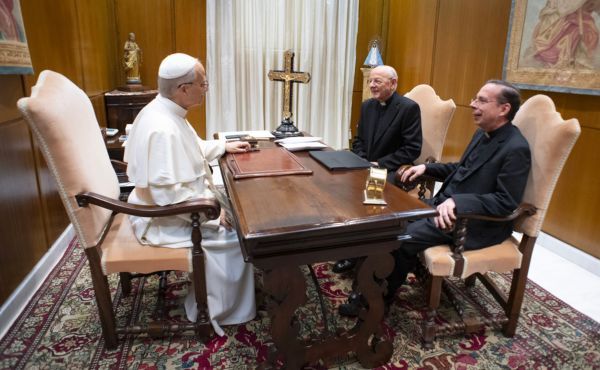

Following Opus Dei’s presentation of the statutes to the Holy See, Exaudi has interviewed Don José Tomás Martín de Agar, Professor Emeritus of Ecclesiastical Law at the Pontifical University of the Holy Cross, a priest and member of the Opus Dei Prelature.
Exaudi: After three years of review, what fundamental considerations have motivated the changes in the statutes and how do they reflect the particular form of government “based on charisma” promoted by the motu proprio Ad charisma tuendum?
In reality, the change that has taken place has been motivated first by the reform of the Roman Curia as a whole (March 2022), which places the Personal Prelatures under the jurisdiction of the Dicastery for the Clergy, removing them from the Dicastery for Bishops in which they were. From then on, the Motu Proprio Ad Charisma Tuendum (July 2022) arrives, in which, in addition to confirming this dependence on the Dicastery for the Clergy, it is suggested that the statutes of Opus Dei be reformed or revised so that the charismatic dimension of the Work is greater and the spirit proper to Opus Dei, which also informs its apostolates, can be better preserved. Reviewing the hierarchical nature of the government of the Work while respecting the secular nature of the ties that unite the faithful with the Prelature.
Exaudi: To what extent might the reform of canons 295-296 (August 2023) have influenced the legal configuration of the Prelature, and what specific innovations does this bring to the new text?
Well, the reform of canons 295 and 296 mentions as precedents in its explanatory statement both the reform of the curia, the aforementioned Praedicate Evangelium , and the motu proprio Ad charisma tuendum. This reform does not refer exclusively to the Prelature of Opus Dei, but although it extends to all possible Prelatures, what is now stated in canons 295 and 296 actually affects only Opus Dei, since it is the only Prelature erected to date. This change establishes that the Prelature, being such, is assimilated to clerical societies of pontifical right with the right to incardinate. It also retains the secular nature of its internal regime, since according to can. 295, its government corresponds to the Prelate (a title that remains unchanged), who governs it as Moderator with the powers of an Ordinary, according to the Statutes of each Prelature. The Prelate is responsible, as before, for establishing the Prelature’s seminary, incardinating and promoting its seminarians to the Orders, and overseeing the formation, support, and ministry of priests in a manner similar to that of diocesan Ordinaries. These have always been secular priests. At the same time, it is recalled that the lay faithful who collaborate in the pastoral mission of the Prelature continue to be, as they have always been, ordinary faithful of the diocese and the parishes to which they belong, normally by reason of their domicile.
Exaudi: How has the dialogue with the Holy See, especially the Dicastery for the Clergy, been? What has been the attitude of Opus Dei?
Saint Josemaría said that we must be faithfully obedient to the Holy Father and the diocesan bishops, that good things will always come to us from the Holy See, which seems obvious to me. In the process of reforming the statutes, which have finally been submitted as a draft to the Holy See for final approval, the leading role, naturally, has fallen to the Prelate, assisted by his collaborators, who has sought to meet occasionally with Pope Francis, the ultimate promoter of this change. On another level, conversations and meetings have taken place between various members, both from the Dicastery for the Clergy and some of the canonists of Opus Dei, to understand, on both sides, the desires of the other. Above all, of course, on the part of Opus Dei, the desires of the Holy See and above all the Holy Father. Furthermore, the members of the Work, from first to last, have obeyed and prayed for a suitable and satisfactory solution to the issues raised by Pope Francis’s motu proprio , since Opus Dei wants and desires to serve the Church as she wishes to be served. Therefore, understanding what the Church, through the Apostolic See, desires is of primary importance.
Exaudi: During this period, you have faced a change of papacy and the “sede vacante”: In what ways has this affected the schedule of the ordinary congress of April 2025 and the process of submitting the statutes?
The process of revising Opus Dei’s statutes came to a sudden halt due to the death of the Holy Father Francis. During this interregnum until the arrival of Pope Leo XIV, Opus Dei participated with the entire Church, both in mourning and in anticipation of the outcome of the conclave. It was normal that during this period the revision of the statutes was not moved forward so decisively and openly, despite the fact that by the time of Pope Francis’s death, the General Congress of the Work, which was to study the draft statutes and eventually give its approval, had already been convened. The Prelate, wisely, considered and preferred, advised by his councils, to suspend and not carry out the entire agenda planned for this congress, but only those aspects that required the renewal of the central offices of Opus Dei. And that was the task that was explicitly carried out. From the message the Prelate himself sent us on June 11, we know that, even so, while mourning the death of Pope Francis and awaiting the election of the new Pope, the congressmen were able to learn about the statutes that were to be presented. The Prelate notes that “the congressmen gave their positive opinion so that, with the new Council and Advisory Board, we could conclude the revision of the Statutes and submit them to the Holy See for approval, which we did today.” Now we must await the Holy See’s response, since the motu proprio on the reform of the statutes of the Work explicitly states that the statutes must be approved or given by the Holy See to the Prelature. We will see how this assignment of new statutes to Opus Dei will unfold.
Exaudi: Once the new statutes have been worked on, what practical changes will members (priests, numeraries, supernumeraries) notice in their daily lives and in the pastoral mission of the Prelature?
I don’t think the members of Opus Dei, based on the new statutes, will find substantial changes in their daily lives. They have made a commitment, both priests and lay people, to seek holiness in the pursuits of ordinary life and to try to spread that same desire to the many people around them. Each according to the state in which they live, priests and lay people of all classes. There may be new ways, which I am unaware of and therefore cannot specify, of the connection of lay people with Opus Dei, but always keeping in mind that the canons regarding this connection have not changed at all. Canon 296 retains the same tenor as it had, with a reference to canon 107. That canon speaks of agreements or conventions with the Prelature that would be the basis of their connection with it. The priests, for their part, will continue to be incardinated in Opus Dei as they have been until now and will retain their status as secular priests. Surely, I think this will happen: both will become involved, as has always been the case, in the pastoral care of the diocese and the parishes where they live, in accordance with the spirit of Opus Dei, which is eminently secular; thus, preserving their character as ordinary citizens and people who dedicate themselves to God wherever they are, without changing their status.

Exaudi Staff
What is Exaudi News? Exaudi News is an international Catholic media outlet that informs, shapes, and transforms daily in Spanish, English, and Italian. Through news, analytical articles, and live broadcasts of the Pope's events, Exaudi seeks to strengthen Christian unity and contribute to the evangelization of the world, always guided by the Church's social doctrine. We work to bring Christian truth and values to every corner of the planet. Help us transform the world with Exaudi! At Exaudi, we believe that evangelization and quality information can change lives. To continue our mission and expand our reach, we need your help. In addition, we are looking for committed people to join our team. With your support, we will reach more people, spread the message of Christ, and strengthen Christian unity. Will you join our mission? For more information on how to collaborate, visit Exaudi.org or contact us directly: [email protected] Exaudi: Informs, educates, and transforms.
Related
From Bustle to Sacred Silence: The Fulfilled Vocation of Parents
Laetare
07 April, 2026
5 min
Poland: Another Step in the Coup d’État
Wlodzimierz Redzioch
07 April, 2026
5 min
What Now?
Javier Ferrer García
06 April, 2026
3 min

It’s not just who you are that matters, but also the world you grow up in
Marketing y Servicios
06 April, 2026
3 min